The idea of \u200b\u200bair transport military troops emerged with the very birth of military aviation in part fueled by the same characteristics of the first allowing aircraft to be operated without airfields and could land on any more or less horizontal space. From there the transport of troops behind the enemy and conduct during World War World (1914-1918)
In 1928 the commander of the Leningrad military district, М.Н. Тухачевский (MN Tuxachevski) began to spread the idea of \u200b\u200bcreating a permanent grouping of soldiers who were transported by air carrying heavy weapons toward the rear of the enemy for military action. Then, only thinking about the landing of these troops on the ground directly in the time since the chute was intended only as a means of salvation of the pilot in case of an emergency.
 The creation of a landing force of paratroopers early so I corresponded Commander Леонид Григорьевич Минов Brigade (Leonid Grigorevich Minova) the first military paratrooper, in fact, the USSR. Minova presented the idea of \u200b\u200busing parachutes aviation in a reunion of the high command of the air force of the USSR in 1928 after which the Commander of Russian Air Force, Петр Ионович Баранов (Piotr Ionovich Baranov, photo sup.) Will from the United States proposed to meet the aviation rescue service.
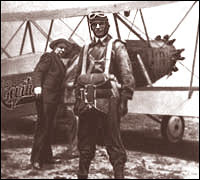
Minova In 1929 he traveled to the United States and once there he was invited to try for yourself the parachute jump at the parachute factory Irwin Buffalo, action the day June 13 by jumping from 500 meters (photo above). After his return to the USSR and having received her Bachelor of paratrooper in the U.S. after his 3rd jump, the Commander in Chief of the Soviet Air Force, Pyotr Baranov, decided the introduction of the paratroopers in aviation. The first step was the instruction of the 11th Air Brigade at the base of the 53rd Squadron in Voronezh by the same Minova was appointed as his assistant Яков Давидович Мошковский (Yakov Davidovich Moshkovski, right in photo inf.) un joven aviador de la 11a brigada aerea. 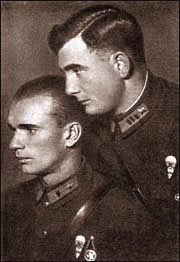 Alli, el 26 de julio de 1930, fecha en que se considera fundado el paracaidismo deportivo sovietico, Minov (izquierda en foto superior) realizo un salto de demostracion en el aerodromo de Voronezh:
"My jump is really a success. Landed I'm easy, not far from the spectators, even stood on their feet. Встретили аплодисментами. Откуда-то взявшаяся девушка вручила букет полевых ромашек "(My jumping was impeccable. Land with facility not far from the spectators, even land up. I was greeted with applause and even a girl who appeared from no where give me a bouquet of chamomile
wild
His assistant, Yakov Moshkovski, also made a parachute jump but its entanglement in a building under construction, however, without major problems came to earth using an emergency ladder construction. Jumps, nevertheless, a positive influence on the audience and led to new jumps between days 26 and 29 making up the number of volunteers finally to 30
 Alli, el 26 de julio de 1930, fecha en que se considera fundado el paracaidismo deportivo sovietico, Minov (izquierda en foto superior) realizo un salto de demostracion en el aerodromo de Voronezh:
"My jump is really a success. Landed I'm easy, not far from the spectators, even stood on their feet. Встретили аплодисментами. Откуда-то взявшаяся девушка вручила букет полевых ромашек "(My jumping was impeccable. Land with facility not far from the spectators, even land up. I was greeted with applause and even a girl who appeared from no where give me a bouquet of chamomile
wild
His assistant, Yakov Moshkovski, also made a parachute jump but its entanglement in a building under construction, however, without major problems came to earth using an emergency ladder construction. Jumps, nevertheless, a positive influence on the audience and led to new jumps between days 26 and 29 making up the number of volunteers finally to 30
For the cadets had to perform the mission entrusted 59 jumps, both training and demonstration, using the parachute Americans of the compan-ia Irwin and flying in a twin-engine Farman Goliath
.

 After reporting to Commander Baranov progress in the course is mandated a new mission, a collective leap of 10-15 people. Mishkovski Minova and enthusiastically accepted the challenge and chose 10 students. Was chosen to do in a Farman Goliath because it would require that the paratroopers jumped from the wings but directly through the door that allowed him to fly together inside the plane before jumping so encouraging strengthen their mood.
.
 Participants air landing. This is the group of Mishkovski who appears on the far left of the photo. At the center appears VG Baranov, the parachute packer.
.
As this plane is not allowed to carry more than 7 passengers decided to make 2 flights, one led by Minova and a second by Mishkovski. In addition, it was decided three aircraft launched from R-1 weapons and military equipment by parachute load.
Thus, the August 2, 1930 at 9 am the first plane took off under the command of the pilot Громов (Gromov). There was a group of paratroopers under the command of Minova but also added his assistant Mishkovski who sought to define the landing site. It chose an area devoid of plantings of 600 by 800 meters near the hamlet of Клочково (Klochkova) to 2 km from Voronezh. The first group (inf picture.) Be launched from 350 feet high completely abandoning the plane in 5 seconds. While the plane was returning for the rest of the landing forces the 3 R-1 planes dropped 2 bags and 4 boxes of various military equipment. The second launch was conducted from 500 meters high and the paratroopers touched down near where he was the first group. After some minutes the group met with all the weapons ready for military action, and left to truck back to the airfield by completing their mission.

The action allowed to demonstrate the possibility of a military landing from the air as well know in detail the technical requirements for the release of both skydivers and the military burden in addition to the times of realization of the different stages of the landing plan, all of which were published in a newsletter and a magazine airline.

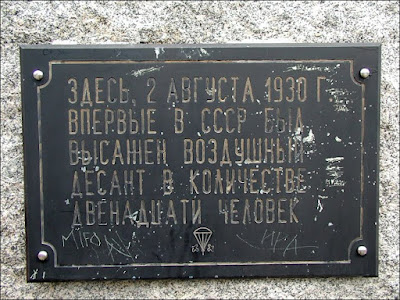 here for the first time in the USSR on August 2, 1930 a group of 12 paratroopers conducted a landing operation.

current place of realization of the first landing air
All preparation led to the filming of a movie called Парашют (the parachute) that was later used by many an-os in this type of instruction.
 here for the first time in the USSR on August 2, 1930 a group of 12 paratroopers conducted a landing operation.
test 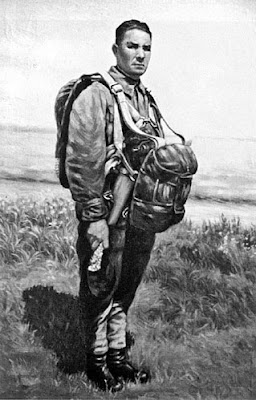
 This military force until 1946 was part of the Russian Air Force (BBC in Russian) and then became part of the ground forces even in direct subordination to the Russian Defense Ministry until finally in 1991 constituted a independent army.
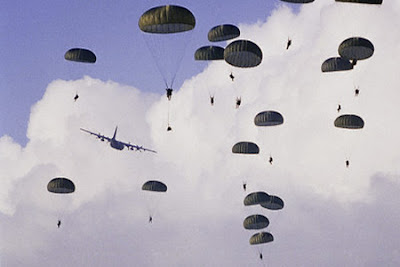
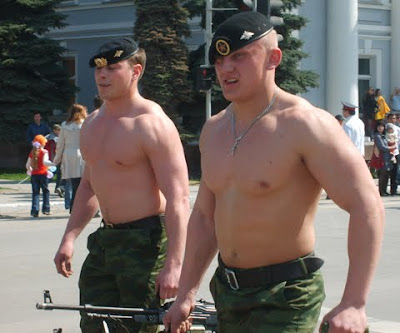
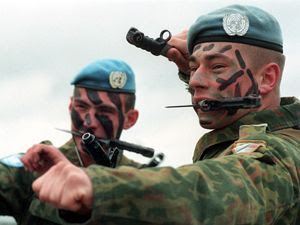
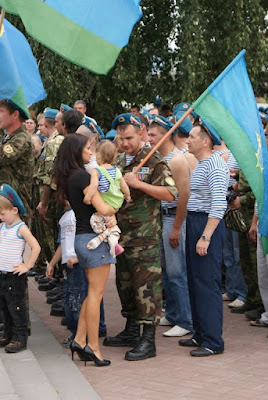
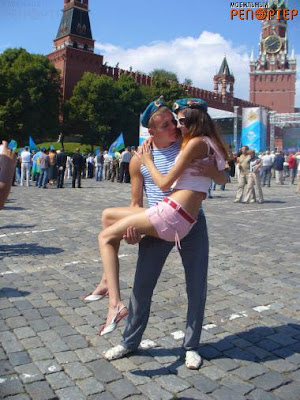
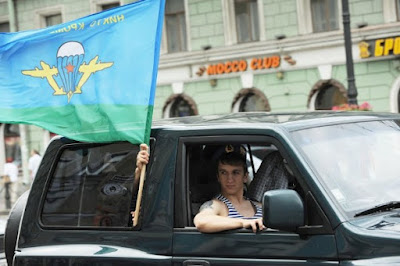
 air landing forces (ВДВ) or simply diesántniki are also known as popular in Russia as крылатая пехота (winged infantry) or голубые берета (blue berets) and are recognized not only by their berets or white ribbons shirts blue (тельняшки, tielniáshki) but also by how earnest and lively, although sometimes too loud, that place every day an-or.
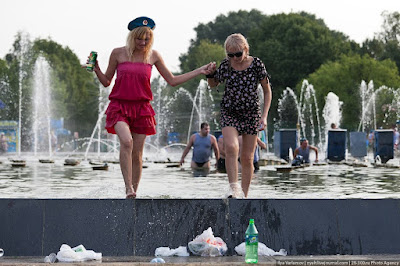
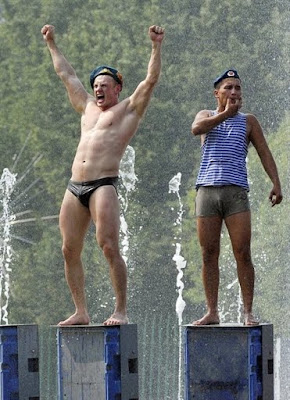
Russian 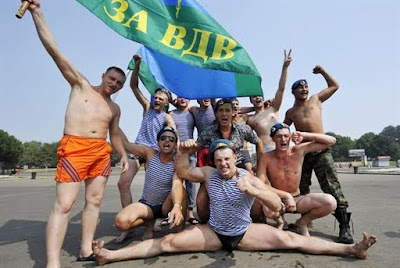 Every city has places where diesantniki traditionally gather to celebrate their day in Moscow so any Moscow knows that during a 2 August is best not to walk on the side of Gorky Park. Despite all this, or an attempt to give a different feel to the celebration in Red Square and took place more formal way of the Prophet Elias day anyway so that the center did not stop the celebrations were the sources of Парк культуры имени Горького (Gorky Park), as a tradition of 2 August is plunging into the fountains of the city, not only Moscow but also in any other city in Russia, and even other countries that were once part of the Soviet Union as the battles that bind to these military parachutists come from what we call time Western World War II through the so-called occupation of Afghanistan and also for subsequent operations in the former Yugoslavia or in territories around the Caucasus.
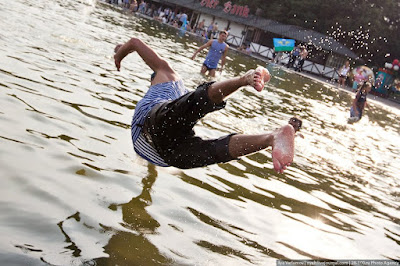
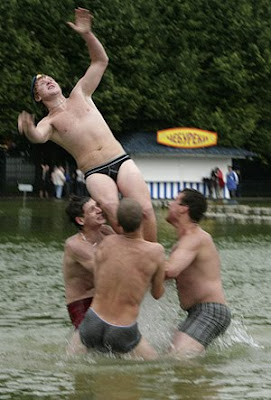
 Another tradition rooted in the celebration and a source of problems, sometimes serious, is the high consumption of alcohol, causing countless Rhine-as between them diesantniki though more usually between them and natives of the Caucasus, it is precisely these past who have been enemies of the Russian usual frontlines as Chechnya, where Russian military parachutists have died or been injured.
 an-o And this was no exception for military paratroopers held its 80 an-os among solemn ceremonies punctuated by some street scandals.
 Some 5 000 diesantniki participated in the celebrations in Moscow while that the order by about 1,500 police were located in their traditional reunion sites in the city. Of those 5 billion, about 2 thousand gathered in Gorky Park and another 2,500 in the park Поклонная Гора (Poklonnaya Gora) with about 300 at the show ВВЦ (VVTs). Another smaller amount held in parks and Измайлово Сокольники (Sokolniki, Izmailovo).
This action allowed the military analysts to show the benefits of the actions of landing from the air, especially its immense potential to encircle the enemy for it in 1931 as the first unit of air landing in the country formed by 164 paratroopers under the command of Commander Е. Д. Лукин (EDLukin) and then the December 11, 1932, the USSR took the decision to form a massive force of air landing.
General Margelov just before its first launch in parachute. Margelov is considered the Father of Russian military parachuting. He had under his direction to Soviet military parachutists for several decades, being in charge of their participation in the "Prague Spring." He is the author of numerous works of military strategy on the role of paratroopers in different battlefields. In the USSR received the title of Doctor of Military Sciences. It is sometimes called the ВДВ (VDV, air landing forces) and troops of Uncle Vasia (diminutive of Vasili, the name of Margelov) because the phrase is abbreviated also as ВДВ: Войска дяди Васи.
.
.
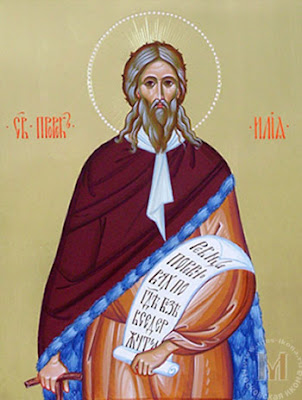
The operation carried out on the outskirts of the city of Voronezh marked the beginning of military parachuting in Russia, so each August 2 in the country celebrated the day of the air landing forces, the date coincides with the day of the Prophet Elias (picture below), which transformed it into the protector of the Russian military parachutists.
This military force until 1946 was part of the Russian Air Force (BBC in Russian) and then became part of the ground forces even in direct subordination to the Russian Defense Ministry until finally in 1991 constituted a independent army. .
These troops have always been present in the areas of greatest risk and require elite forces have also participated in areas where work is done in peace and anti-terrorist operations.
air landing forces (ВДВ) or simply diesántniki are also known as popular in Russia as крылатая пехота (winged infantry) or голубые берета (blue berets) and are recognized not only by their berets or white ribbons shirts blue (тельняшки, tielniáshki) but also by how earnest and lively, although sometimes too loud, that place every day an-or. Every city has places where diesantniki traditionally gather to celebrate their day in Moscow so any Moscow knows that during a 2 August is best not to walk on the side of Gorky Park. Despite all this, or an attempt to give a different feel to the celebration in Red Square and took place more formal way of the Prophet Elias day anyway so that the center did not stop the celebrations were the sources of Парк культуры имени Горького (Gorky Park), as a tradition of 2 August is plunging into the fountains of the city, not only Moscow but also in any other city in Russia, and even other countries that were once part of the Soviet Union as the battles that bind to these military parachutists come from what we call time Western World War II through the so-called occupation of Afghanistan and also for subsequent operations in the former Yugoslavia or in territories around the Caucasus. Despite the above many of those involved in the celebrations in the streets and parks are recruits who performed his military service (2 an-I in Russia) in the air landing forces and not veterans is neither forces nor exercise.
.
Another tradition rooted in the celebration and a source of problems, sometimes serious, is the high consumption of alcohol, causing countless Rhine-as between them diesantniki though more usually between them and natives of the Caucasus, it is precisely these past who have been enemies of the Russian usual frontlines as Chechnya, where Russian military parachutists have died or been injured. an-o And this was no exception for military paratroopers held its 80 an-os among solemn ceremonies punctuated by some street scandals. Some 5 000 diesantniki participated in the celebrations in Moscow while that the order by about 1,500 police were located in their traditional reunion sites in the city. Of those 5 billion, about 2 thousand gathered in Gorky Park and another 2,500 in the park Поклонная Гора (Poklonnaya Gora) with about 300 at the show ВВЦ (VVTs). Another smaller amount held in parks and Измайлово Сокольники (Sokolniki, Izmailovo). .
 Moscow hospitals received a total of 13 diesantniki injured, 9 of whom suffered minor trauma consideration for being very drunk but remained hospitalized. Moscow were also detained 24 of them but quickly regained his freedom.
The only serious event in the country happened in the city of Moscow, is a wheel-a in the square Манежная about 22:30 pm in which 3 young paratroopers were involved with a group of natives of Dagestan region (region of southern Russia near Chechnya). The paratroopers, heavily drunk, were instigated to fight for a much larger group of Dagestan. Two of the paratroopers, both 23, were hospitalized victims of a TEC while the third, 29, was shot in his abdomen.  detainees after the wheel-a reached 15, all from Caucasus. According to witnesses it was they who attacked the diesantniki.
 Another violent, but no victims occurred in the city of Екатеринбург (Yekaterinburg) in the number 56 in Bauman Street. Alli three diesantniki entered a cafe and asked to be served watermelon. Local employees, Caucasian, they replied that they were selling fruit and watermelon that if they wanted to leave to another place.
 The rest of the story is as yet unknown, the only known eyewitness claiming that about 15 minutes before midnight had gathered outside the cafe about 40 diesantniki who started throwing bottles beer to the local windows but no one could say that among them were the 3 who had asked, unsuccessfully, watermelon in the cafe. As a result the glasses were broken and was given local-ado a refrigerator located in the suburbs also were destroyed pots of flowers and lanterns. After the action the diesantniki withdrew without producing any fight with the Caucasians.
 Additionally, in the city of Krasnodar diesantniki 65 were arrested, 15 of them being sent to a detox center since his alcoholic drunk.
 Despite the above situations Ирина Петрова (Irina Petrova) representative of the department of public policy of the Russian Interior Ministry, stated that celebrations of August 2 and is carried out in 340 Russian cities were carried out without major problems. They took part about 106 thousand people who were guarded by about 22 thousand police, 1,600 special forces and 1,400 armed members of the Ministry of Interior in addition to other services of private guards.
Moscow hospitals received a total of 13 diesantniki injured, 9 of whom suffered minor trauma consideration for being very drunk but remained hospitalized. Moscow were also detained 24 of them but quickly regained his freedom. The only serious event in the country happened in the city of Moscow, is a wheel-a in the square Манежная about 22:30 pm in which 3 young paratroopers were involved with a group of natives of Dagestan region (region of southern Russia near Chechnya). The paratroopers, heavily drunk, were instigated to fight for a much larger group of Dagestan. Two of the paratroopers, both 23, were hospitalized victims of a TEC while the third, 29, was shot in his abdomen.
.
detainees after the wheel-a reached 15, all from Caucasus. According to witnesses it was they who attacked the diesantniki. Another violent, but no victims occurred in the city of Екатеринбург (Yekaterinburg) in the number 56 in Bauman Street. Alli three diesantniki entered a cafe and asked to be served watermelon. Local employees, Caucasian, they replied that they were selling fruit and watermelon that if they wanted to leave to another place. The rest of the story is as yet unknown, the only known eyewitness claiming that about 15 minutes before midnight had gathered outside the cafe about 40 diesantniki who started throwing bottles beer to the local windows but no one could say that among them were the 3 who had asked, unsuccessfully, watermelon in the cafe. As a result the glasses were broken and was given local-ado a refrigerator located in the suburbs also were destroyed pots of flowers and lanterns. After the action the diesantniki withdrew without producing any fight with the Caucasians. Additionally, in the city of Krasnodar diesantniki 65 were arrested, 15 of them being sent to a detox center since his alcoholic drunk. Despite the above situations Ирина Петрова (Irina Petrova) representative of the department of public policy of the Russian Interior Ministry, stated that celebrations of August 2 and is carried out in 340 Russian cities were carried out without major problems. They took part about 106 thousand people who were guarded by about 22 thousand police, 1,600 special forces and 1,400 armed members of the Ministry of Interior in addition to other services of private guards. 


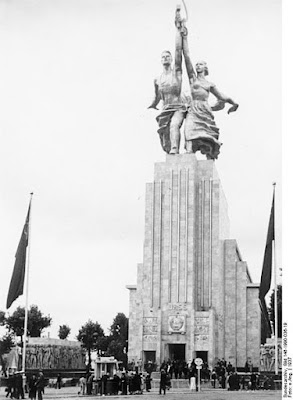
 The USSR was assigned a place in Paris along the Seine in 160 by 21 meters. There, the Soviets set up their pavilion, a building 150 meters long and at its front, 34 feet high, installed the sculpture of Worker and Peasant. By an irony of fate all got up in front of the Pavilion of Nazi Germany, so that the symbols of Soviet ideology and looked straight in the direction opposite of the symbols of Nazi ideology, the eagle and swastika.


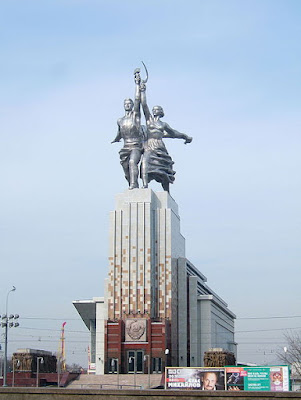 The sculpture was mounted on a pedestal again, 10 meters higher than the previous copy of that used in the Paris World Exhibition in 1937 (