 In architecture and decoration of an Orthodox church there is nothing else. Every detail has a profound meaning and tries to also lead to a greater or lesser extent to the salvation of the soul.
In the first place, the Orthodox churches are built to the east, ie the side of light where the sun rises because Christ is the light. In addition, each temple is dedicated to a saint or a holy fact.
The base of the building may have different shapes: a cross representation of the cross where Jesus died, evoking the eternal circle of Sen-or, an octagon imitating a star that guides us through the world or in a manner similar to a long boat representing Noah's Ark takes us through the stormy waters of life into the peace of the kingdom of heaven.
concludes the construction itself at the top in one or more domes that represent the sky and on top is crowned by a sin-a field on which to erect a cross in honor of the head of the church, Jesus Christ . A single dome represents Jesus Christ, two represent the earthly and divine nature, three of the Most Holy Trinity, 5 represent Jesus and the Apostles 4, 7 to 7 and 7 Sacraments universal church, 9 to the nine ranks of angels, 13 Jesus and 12 apostles. The number of domes, however, also may be higher.

 The shape of the dome also has a symbolic meaning. Helmet-shaped (picture immediately above) represents the battle against the forces of evil by the Church as if it is the classical form of onion (prior to the previous image) represents the flame of a candle recalling the words of Jesus "You are the light of the world (Вы-свет миру, V-svet miru).
The golden color of the dome represents the heavenly glory. So domes are present in the mainline churches and those consecrated to Christ and the 12 most solemn holidays of the Orthodox Church. The blue domes with stars are consecrated to the Blessed Mother because the star recalls the birth of Christ from the Virgin Mary. The churches of the Trinity had domes is the color green because the Holy Spirit (Святой Дух, Svyatoy Dux), while those devoted to the saints are crowned with green or silver domes.


 In Russian Orthodoxy is customary to have 6-8 in each temple of these domes topped with crosses, crosses that always face west and are distinguished from the Latin cross in the presence of two stringer additional os shorter than the central sill-o: a top and bottom and steep.
 Evolution of the orthodox domes between VIII and XVIII centuries
Types of crosses on the domes
The Orthodox cross the sill, or bottom is tilted (косое подножие, koso podnozhie, pedestal inclined) representing the balance of the Last Judgement that can be tilted toward the sky or otherwise to the ground. The foot of the cross receives Russian стояло name (stoyalo) and its left side ( for the observer looking toward the temple since its accession ) that slopes upward. The sill-or higher as is the board with the inscription in Latin, INRI.
 Sometimes it can be seen leaving the center of the cross lines or oblique lines. Are representation of the sun, source of light and heat without which life is not possible as the sun is representation of Christ as the source of eternal life. Many times, blacksmiths add 12 small as stars at the ends of the rays of this central star evoking a story of the Apocalypse of John in which the number 12 evokes both the 12 tribes of Israel as the 12 apostles.
 The crescent on the bottom of some crosses represents a chalice. While some people seem to evoke the Muslim faith was a state symbol, and also Christian, Byzantine, originally representing an anchor according to one of the Letters of St. Paul that makes a comparison between the work of an anchor to hold a boat and the strength that gives the Christian faith to the soul. Only after 1453, with the capture of Constantinople by the Turks, the crescent step to be an official symbol of the Ottoman Empire.
The steeple (Колокольня , kolokolniya )
 Above the entrance of the church or sometimes next to the building is built a tower that is used to invite the faithful to prayer and also to announce main parts of the religious services are held in the church. It is a tower-shaped building that is separate from the church or part of it. The bells are installed at different levels according to their size and weight.
The son of a single bell called благовест (Blagovest) and announces the mass. The long-er of all steeple bells made for special holidays and is called трезвон (trezvon) while in case of a tragic event called перезвон (perezvon).
 Another type of bell, called in Russian Zvonnitsa (Звонница) which differs from the bell tower that is not built into a tower but a temple wall. It can be seen both in the picture above as in the previous to this, in the building to the left of the bell tower
INTERIOR ARCHITECTURE
As temples of the Old Testament were divided into 3 parts: Sancta Sanctorum, sanctuary portico and Orthodox churches also are divided into 3 parts: Altar , middle of the church or temple as such and anteiglesia .

general scheme inside the Orthodox church. The upper part, located to the east, home to the Altar. At the center of the plane stands the temple itself, where the faithful, standing, listening to religious service. There is a dividing wall between the altar and the Temple, called iconostasis despite the Altar, which is at a higher level with regard to the Temple, extends slightly beyond the iconostasis. To the west is the parish church or court, which can be physically separated from the temple by a wall or door
The altar The altar is the most holy place of the temple and represents the heavenly kingdom. The entrance is restricted only to the ecclesiastics. Women are forbidden except to the nuns and if they receive the blessing of the top of the temple.
The altar, which represents the place where was held the Last Supper is the sacrament of communion of the body and blood of the Sen-or in the form of bread and wine. As a rule has 3 windows, symbolizing the 3 lights of the deity representing the trinity of the divine.
 The image above able to see the end opposite the input, ie, looking from the east, the apse, hemispherical construction can be observed also in the lower level
 The graph above allows a closer look inside the Altar, but the West (down in the illustration) shows the 3 doors of the iconostasis (North, South and real doors) and then the Post Altar is the level below floor of the Altar to finish in Ambon, after which the floor level is situated in a slightly lower level giving Start the Temple. The altar has 3 important elements: The Holy Table, the table of the altar and the space within the place called heaven Abside
The central sector of the eastern hemisphere-shaped altar, the apse. In and near the wall is a small elevation which is situated on a chair for the bishop representing the throne on which invisibly take a seat on Sen-or ( Visible in the picture below to the bottom and below the image of Christ ) . This sector is called heavenly place (Горнее место, Gornee mesto) and the bishop represents Christ himself when it occupies this location while the priests represent Holy Apostles.
 On the altar there is also a special candelabra with 7 branches that are located on the eastern side of the holy altar table (Table visible in the foreground in the picture above ) and in front of Gornee mesto. The candlestick ( Светильник, svetilnik. Visible previous image after the Santa table and more clearly in the picture below ) represents the Tree of Life of paradise while the number of sails the 7 Sacraments (Семь таинств, Sem tainstv) of Orthodox Church ( Baptism, Confirmation, Eucharist, Confession, Grace, Extreme )
 The Santa Mesa

 The main body is the holy altar table (Святой Престоль, Svyatoy Prestol) or trapeza in Greek that is as it is sometimes also called in Russian Orthodox ecclesiastical in missals. During the first centuries of Christianity, churches underground catacombs of the role of this table was made by the grave of some martyr who had necessarily rectangular in shape and was located next to the altar wall.
The holy table represents the heavenly throne of God in which he resides and 4 sides symbolizes that the Christian message is universal.
 The altar table is covered by 2 pan-os: A white one called Срачица, srachitsa in Russian and Greek katasarkion representing the Holy Shroud which enveloped the body of Christ on his deathbed. On another pan-or called in Russian индития (inditiya, previous image), the Greek endian (I cover) that represents the glory of the Lord's throne. During the consecration of the temple the bottom cover is wrapped with a rope that symbolizes the bonds with which Jesus was bound to be brought to trial before the first priests. The rope is wrapped around the altar so that doubling the 4 be a cross sides.
 The main element of the altar table is the Antimins (top) from the Greek anti, instead of, and the Latin mensa table. This pan-or remembers the time when Christians were persecuted and the church had no permanent residence so that his followers could not carry the throne (altar table). Then he began to use this pan-or with the remains of relics. It is the most sacred object of the temple and, in fact, without the antimins can not perform the religious service. Usually antimins wrapped in another pan-o (iliton) that evokes the bandage on the head of Christ on his deathbed.
The antimins is a pan-or silk with an image of Jesus in the tomb along with images of the 4 evangelists. On the back the antimins carries a bag with holy relics. Delivered by the bishop to the priest during the consecration of the church that you can perform the religious liturgies. Folds into 4 parts before being put on the table and is surrounded by a pan-or silk, of much greater size as iliton called, from the Greek word for wrap.
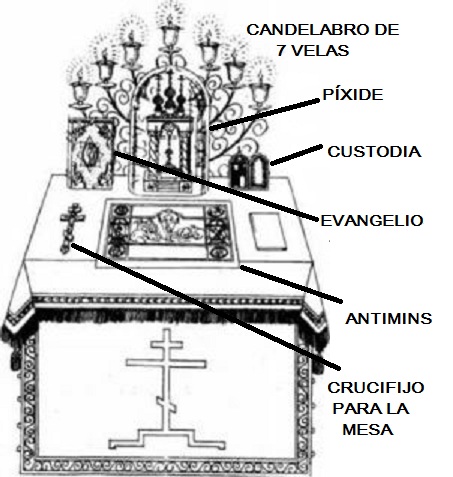 addition to this element, and as shown in the diagram above, the altar table are the Gospel, a container in the shape of the tomb of Sen-or to save the sacraments (Дарохранительница, daroxranitelnitsa. Pyx in Spain-ol), another container equivalent (Дороносица, Doronositsa. Custodia) but used to give communion in enclosures located outside the church (a hospital for example) a cross to the table (Престольный крест, Prestolni Krest ), also the candlestick upon the table (Светильник, Svetilnik).
 On the north side of the altar there is another table ( against which the priest appears in the picture above ) in which at the beginning of the liturgy are preparing the elements of the Eucharist. It is called Predlozhenie (offertory) because in ancient times there was offered to the faithful the bread and wine. Also called Zhertvennik (altar). It prepares the bread and wine for the Eucharist.
During the rites of the first part of the Orthodox liturgy (called Proskomidiya) on this table are the elements for the Eucharist and other holy objects that are seen below:

 The calyx (1) is the container in which the beginning of the liturgy the wine is poured with a very small amount of water, wine during the liturgy becomes the blood of Christ. The star-shaped arches (2) are two arcs together in a cross (in picture below on the plate or bowl of communion wafers), evoking the Star of Bethlehem. Are placed on the plate (3) to prevent the mantle or cubrepatena touch parts of the host. These beds (shown in picture after next) cover or the paten or the chalice but there is also a third larger than the covers on both. The paten is a round metal dish covered with gold or silver to put the hosts (picture below).

 The double-edged sword and spear-pointed tool (4) is used to cut the host and evokes the spear that wounded Christ on one side as he lay on the cross. Teaspoon (5) is used to give communion to people without ecclesiastical rank. (6) is a metal fan (Bottom. They are used in pairs) to ventilate the elements of communion but now has a rather symbolic meaning. The two candlesticks (7) and three (8) candles represent, respectively, the divine and earthly nature of Christ and the Holy Trinity.
 appear after a censer (9) and Santa Mesa elements: the chest to the sacraments or custody (10) and the crucifix to the Holy Table (11)
Continuing space the temple called Altar, to the right of the Holy table, usually in a separate enclosure, is the recipient (Сосудохранилище, sosudoxranilishche) where calyces are saved when you perform a religious service (Священные сосуды, sviashchennye sosudy) and the sacristy (Ризница, riznitsa) where they keep the costumes of priests (Облачные духовенства, oblachenie duxovenstva).
the side of the candlestick of 7 candles, to the north and south sides of the holy table is usually put on antlers an icon of Holy Mother (north side) and the cross with an image of the crucifixion (On the south side). In addition, right or left of the holy table stands a sink to wash hands of priests before the liturgy and the ablution of the mouth after it and also is located where the incense burns (Кадило , kadilo).
incense (Каждение в храме)
 incensing takes place during the service availing of the censer, a metal container which adds incense (Фимиам, Fimiam) on carbon incandescent lets out a aromatic fragrance. You can perform a full censing the church-wide or partial, are incensed the altar, the iconostasis and parishioners. The parishioner must bow slightly to be incensed. In this rite the fire represents the divine nature of Christ, the earthly nature of carbon while the incense are the prayers of the faithful to the Sen-or that being accepted by Christ are transformed into aromatic fumes of incense.
The iconostasis
 the first temples in the middle Byzantine church was separated from the altar for a sin-a barrier that began to grow gradually reaching height in the sixteenth century tall enough to accommodate up to 5 rows of icons, religious images today but are painted on the oldest churches were recorded.
The number of these rows of icons is not regulated, however, Russian Orthodoxy typically uses 3 to 7 but with a total of 5 in the great cathedrals. Additionally, we recommend leaving the top open or at most grating to let you hear the cries of the priests who are inside the Altar.
As a rule the iconostasis must have 3 doors, 2 side (north and south) of a single sheet with a width between 0.6 and 0.9 meters and height of about 2.1 meters but another central double-leaf door located in the center, with special decoration and a width of 1.0 to 1.4 meters and a height of 2.5 meters. These
and 2 central doors are called Царские брата sheets (Tsarskie Brata or royal doors) and allow direct access to the Holy Table. Through these doors and during the liturgy (Mass morning) are carried to the Temple's Holy Sacraments. The door can only be crossed by the Orthodox clergy.
 Priest across the iconostasis through the central doors, or real. After the leaves of the doors and on the altar and immediately observed the Santa Mesa. You can see the icons on the sides of the gates real on the iconostasis
side doors are called deacons (Диаконские, diakonskie) as they cross through the deacons. To the right is located the south gate and on the left side, the north.

The upper diagram shows the Altar (1), space within the Orthodox Church that extends to the ambo (3.1). The number 2 shows the central doors of the iconostasis and 2.2 and 2.3 the side doors. 2.2 is on the north side and 2.3 on the south side
After crossing the royal doors there is a curtain ( marked as 2 in image below) that opens or closes at various times of religious service. Its opening symbolizes the revelation to the people of the secrets of his salvation while opening the door symbolizes the revelation of the true believers of the Kingdom of heaven. To the right of the royal doors in the iconostasis is an icon of the Savior, left an icon of the Most Holy Mother of Sen-or beyond and they have icons of saints especially revered. Along with this, more to the right of the icon of the Savior is located the icon of the temple, that is, the saint or the feast which is devoted to the church for it on the bottom row of icons on the iconostasis is called the local row .
 The number 2 shows the curtain, usually red, which separates the altar iconostasis after crossing the real doors while the number 1 shows the space between the top of the iconostasis and the limit of Arc so that they are clearly audible cries of the priests placed inside the Altar
 The part of the altar in front of the iconostasis is called Solely in Russian, Greek for "Elevation in the middle of the temple." Into this space, equivalent to a kind of Post Altar, is the ambo, the Greek rising. The Ambon symbolizes the ride-on from which he preached Christ as also the grotto in Bethlehem where he was born and the stone from which the angel announced to women advancement of Christ. Here the priest pronounces the words more meaningful religious service.
 Altar The post ends are called in Russian klirosi (vocals), there are banners Orthodox (Хоругвь, Jorugv) with representations of Christ, the Holy Mother or the saints and used in processions. Can be seen in the picture above and also in the following (along with a font).
 rows of icons on the iconostasis
whereas the upper five rows ( 5 in diagram below) is called the Patriarchs (Праотеческий, praotecheski) of the people of Israel and, among others, has images of Adam, Abel, Noah, Enoch and Abraham and the center has an icon of the Trinity or God. The following ( 4 ) is the row appear Prophets and Old Testament prophets with scrolls with their prophecies in his hands. The central icon in this row is an image of the prophecy of the Virgin Mary embodying the prophecy of Isaiah about the birth of a nin-or would be called Emmanuel. The Blessed Mother appears with praying hands on his chest is a circle, symbol of eternal life which is part of an image of Christ that a gesture of his mother.
The next row is the main iconostasis ( 3) where there are three main icons: In the center of the Savior on the throne, left the Virgin and John the Baptist on the right who ask Sen-or no judge too severe to mankind for their sins and show mercy. To this is added usually archangels, apostles and saints in prayer asking for mercy also the trial of Christ.
The fourth row is the holidays (2 in diagram below), which recounts the birth of Christ and his life on Earth coincide with festivities ecclesiastical, from there to the main themes of the icons are, among others , the Annunciation, the Birth of Christ, the Epiphany, the Transfiguration, the Resurrection of Lazarus and the Entry to Jerusalem. This row usually has 12 icons.
 The lower level of the iconostasis (Нижний ярус, Nizhnii Yarus) is called vernacular or local. because the there is a local icon, that is, an icon or a holy celebration in honor they built the temple. To the right of the doors is an icon of Christ the Savior (Спаситель Иисус Христос, Spasitel Iisus Xristos). A little further to the right is the south gate (iuzhnaya dveře) in which there icon of an archangel. More to the right and in the same direction could also be other icons. On the left is the icon of the Mother of God (Божия матерь, Bozhiya mater) and most other icons to the left.
That is the traditional arrangement of the iconostasis, but sometimes may have some variations. You
 the iconostasis icons are installed in the walls of the temple, in large boxes or frames (Киот, Kyoto, previous image) and also on the podium of the temple (Аналой, analoy, picture below).
 The temple or part average church
This sector represents the world of the senses and is also called temple (Храм, Jram). It's where the faithful are present at Mass (Богослужение, bogosluzhenie) and that after the vision of God's grace given in the sacraments become redeemed, sanctified, and partakers of the divine realm.
 Image the middle of the temple with the tablet (analoy in Russian) in the foreground, tilted table decorated with an icon for the reading of the Gospels
The differences in vertical the middle of the temple also have meaning: The upper is the visible sky, the large chandelier lights represent the stars and the large chandelier (Паникадило, panikadilo. It means a lot of lights in Greek) symbolizes the circle of the planets while the bottom represents the earth .
 In the temple, usually along the north wall or in the center, also found the Канун (Kanun, following pictures), rectangular table with metal or marble on which are placed small candles years and has a crucifix on his back. Candles should be lit during the celebration of Mass with the exception of the week saint.

 The parvis
 is the western sector of the temple, usually separated by a partition (Глухая стена, gluxaya stena) from the middle of the temple. From here you enter the temple. Usually this area is roofed and surrounded by walls forming an atrium, which represents the irrational world, the world of sin.
The atrium was the place where once were present who were preparing to receive baptism and penitents who were temporarily excluded from communion. In the churches of monasteries are also often used as a dining room.
Decorating the walls of the temple
icons and paintings on the walls, vaults and columns of Orthodox churches conform to strict rules developed in the time of the Byzantine church. While there are some variations to this day remains the overall scheme.
 The temple and his paintings make a book intended for your understanding. You should read this book from top to bottom being the top and bottom heaven on Earth. The church interior is completely painted as this under the watchful eye of God, omnipotent and all-seeing. Its representation is present in the dome, the highest point of the temple (Picture above). God in the Orthodox tradition is represented in the form of Jesus Christ with a book in his left hand while the right to bless the universe.
 Orthodox churches in the forces of heaven are shown at the foot of the Sen-or, at the bottom of the domes or in the spaces between windows of the towers that support the domes.
Along the walls of the church develops the story of the Gospels. In the eleventh and twelfth centuries as the system of the 12 major Christian holidays according to the facts of the Gospels that are displayed on the walls starting in the southeast and then following the direction of clockwise:
The annunciation, the birth of Christ, Candlemas, baptism, the resurrection of Lazarus, the transfiguration, the entrance to Jerusalem, the crucifixion, the descent into hell, ascension, descent of the Holy Spirit to the Apostles, the rise of the Virgin.
 Stresses also the decoration of the west wall, the farthest from the altar. Often is occupied by an image of Judgement (Страшный Суд, Strashnyi south. Image above) because out of the temple through the western gate everyone should remember the time you finish your earthly life and is to appear before the Judgement end as well not to forget their responsibility in their daily lives. However, there may be other scenes such as the Assumption of the Virgin (Успение Богоматери, Uspenie Bogomateri) or the Last Supper (Тайная вечеря, taynaya vechera) .
 The Byzantine iconography show God has a halo star, a cross Christ and the saints with circles
The temple walls have paintings with stories of sacred history, the Old Testament, New Testament, biographies saints, ecumenical councils up to the very history of the state and locality. The set of issues seems limited at the commencement repetitive, however, no church inside is equivalent to another.


